HRNK 소식
[04/25/2024] HRNK Board Elects New Co-Chair & Co-Vice-Chair, Bids Farewell to Outgoing Directors
[03/29/2024] Russia Vetoes UN Panel of Experts, HRNK Calls for Alternative Monitoring Procedure
[03/07/2024] HRNK Launches Updated Report Based on Satellite Imagery of N. Korea’s Political Prison Camp No. 25
[10/19/2023] Executive Director Greg Scarlatoiu to Testify at Congressional Hearing (10/24)
[10/17/2023] The Committee for Human Rights in North Korea (HRNK) Launches Report Based on Satellite Imagery of North Korea’s Political Prison Camp No. 16 and the Punggye-ri Nuclear Test Facility

의회 청문회
[10/24/2023] From Bait to Plate - How Forced Labor Taints America's Seafood Supply Chain
Forced labor in China taints the world’s seafood supply chain. PRC-based companies that use the forced labor of Uyghurs and North Koreans process a large amount of seafood for the U.S. market. From fish sticks to calamari—these products end up in the supply chains of major restaurants and wholesalers and in the lunches served at American schools and military bases. Recently published reports by The Outlaw Ocean Project detail how forced labor is rampant in China’s seafood industry, including modern slavery on China’s illegal, unreported, and unregulated (IUU) fishing fleet, and in processing plants located in Shandong province of China—where Uyghurs are employed in labor transfer projects. There is also emerging evidence that North Koreans are also working in the fish processing industry in Liaoning province. Squid, pollack, baby clams, and crab are just some of the imports that make it onto the plates of American consumers.
U.S. imports of seafood caught or processed with forced labor may be prohibited under the Uyghur Forced Labor Prevention Act (Public Law 117-78), the Countering America’s Adversaries Through Sanctions Act (Public Law 115-44), and other laws. Nevertheless, the U.S. Government, major grocery chains, and restaurants continue to purchase seafood caught and processed using forced labor in China.
This hearing will continue the CECC’s efforts to ensure that PRC goods and products made with forced labor do not enter U.S. markets. Witnesses will provide testimony about the human rights abuses on board China’s IUU fishing fleet, the seafood supply chains tainted by forced labor in China, and the exposure of the U.S. Government and American consumers to these supply chains. Witnesses will also provide recommendations for U.S. action.
The recording of the hearing is available to view at https://www.youtube.com/live/jYHqJvLrQNU.
[06/13/2023] North Korean Refugees and the Imminent Danger of Forced Repatriation from China
On June 13, 2023, the Congressional-Executive Commission on China (CECC) held a hearing on the subject of "North Korean Refugees and the Imminent Danger of Forced Repatriation from China."
You can find details about the hearing on the CECC's website at this link, and watch the YouTube recording of the hearing at this link.
Ambassador Robert King (former U.S. Special Envoy for N. Korean Human Rights Issues) and Ambassador Jung-Hoon Lee (former ROK Ambassador-at-Large for N. Korean Human Rights), both members of HRNK's Board of Directors, provided live testimony.
Suzanne Scholte, Co-Vice-Chair of HRNK's Board of Directors, also submitted written testimony in her capacity as the Chair of the North Korea Freedom Coalition.
HRNK was invited to submit written testimony for this hearing, with an emphasis on the situation of officially dispatched North Korean workers in China.
Our full testimony is available on the CECC's website at this link.
In our testimony, we compiled the latest available information from North Korean escapees and prominent activists in the North Korean human rights community. This information was gathered between June 2 and June 7, 2023.
One source noted in particular that "North Korea's Ministry of State Security officers are likely to impose harsher punishments than before [on repatriated refugees] and extort [
[12/12/2017] Protecting North Korean Refugees: Written Statement by Roberta Cohen, HRNK Co-Chair Emeritus
"PROTECTING NORTH KOREAN REFUGEES"
House Foreign Affairs Committee
Subcommittee on Africa, Global Health, Global Human Rights, and International Organizations
WRITTEN STATEMENT OF ROBERTA COHEN, CO-CHAIR EMERITUS, COMMITTEE FOR HUMAN RIGHTS IN NORTH KOREA (HRNK) ON “PROTECTING NORTH KOREAN REFUGEES” AT THE HEARING OF THE SUBCOMMITTEE ON AFRICA, GLOBAL HEALTH, GLOBAL HUMAN RIGHTS, AND INTERNATIONAL ORGANIZATIONS, DECEMBER 12, 2017
My appreciation to Congressman Christopher Smith and Ranking Member Karen Bass for holding this hearing to maintain a spotlight on North Korean refugees and their need for international protection. The world community’s preoccupation with massive movements of people fleeing war-torn countries has often overlooked the plight of smaller groups of refugees in desperate straits. The North Korean case is one such situation that should warrant international attention because of the extraordinary cruelty to which the asylum seekers and refugees are subjected. Unlike most governments, North Korea has made it a criminal offense to leave its country without permission, thereby preventing its citizens from exercising their internationally recognized right to seek asylum and become a refugee. Second, those who do try to escape face increasing obstacles -- electrified fences, enhanced border patrols, exorbitant bribes, and traffickers. Only 1,418 managed to reach South Korea in 2016. Third, if caught and returned, North Korean refugees are subject to systematic and brutal punishment, which the United Nations Commission of Inquiry (COI) has found to constitute crimes against humanity.[1] Fourth, neighboring China collaborates with the DPRK in arresting and turning back North Koreans despite the abusive treatment they routinely suffer a
팟캐스트
[03/30/2022] Together for Persecuted Christians in North Korea
[06/09/2021] Greg Scarlatoiu on the John Batchelor Radio Show June 9, 2021
[02/08/2021] Greg Scarlatoiu on the John Batchelor Radio Show February 8, 2021
[01/20/2021] Greg Scarlatoiu on the John Batchelor Radio Show January 20, 2021
[09/24/2020] Greg Scarlatoiu on the John Batchelor Show September 24, 2020
행사
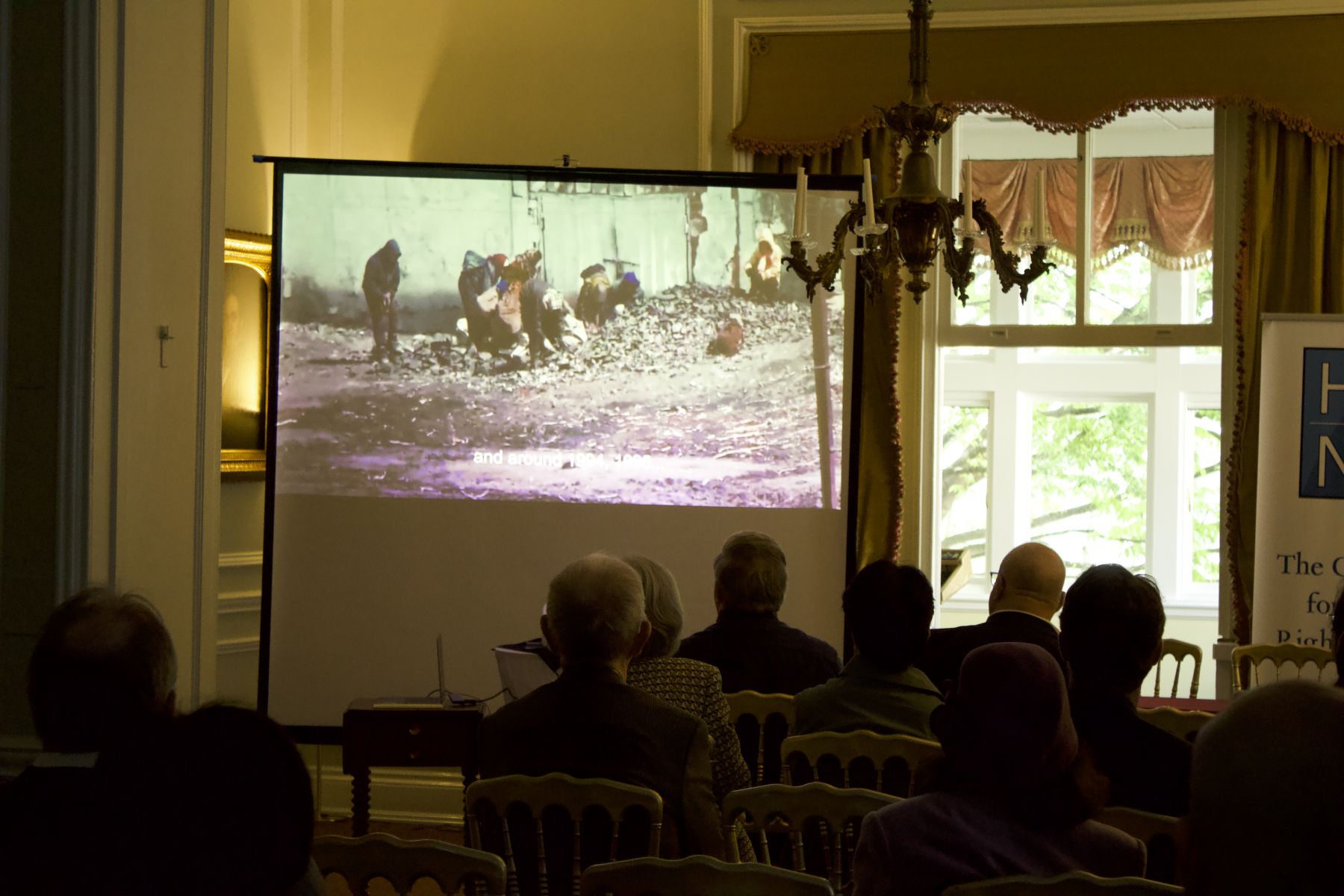
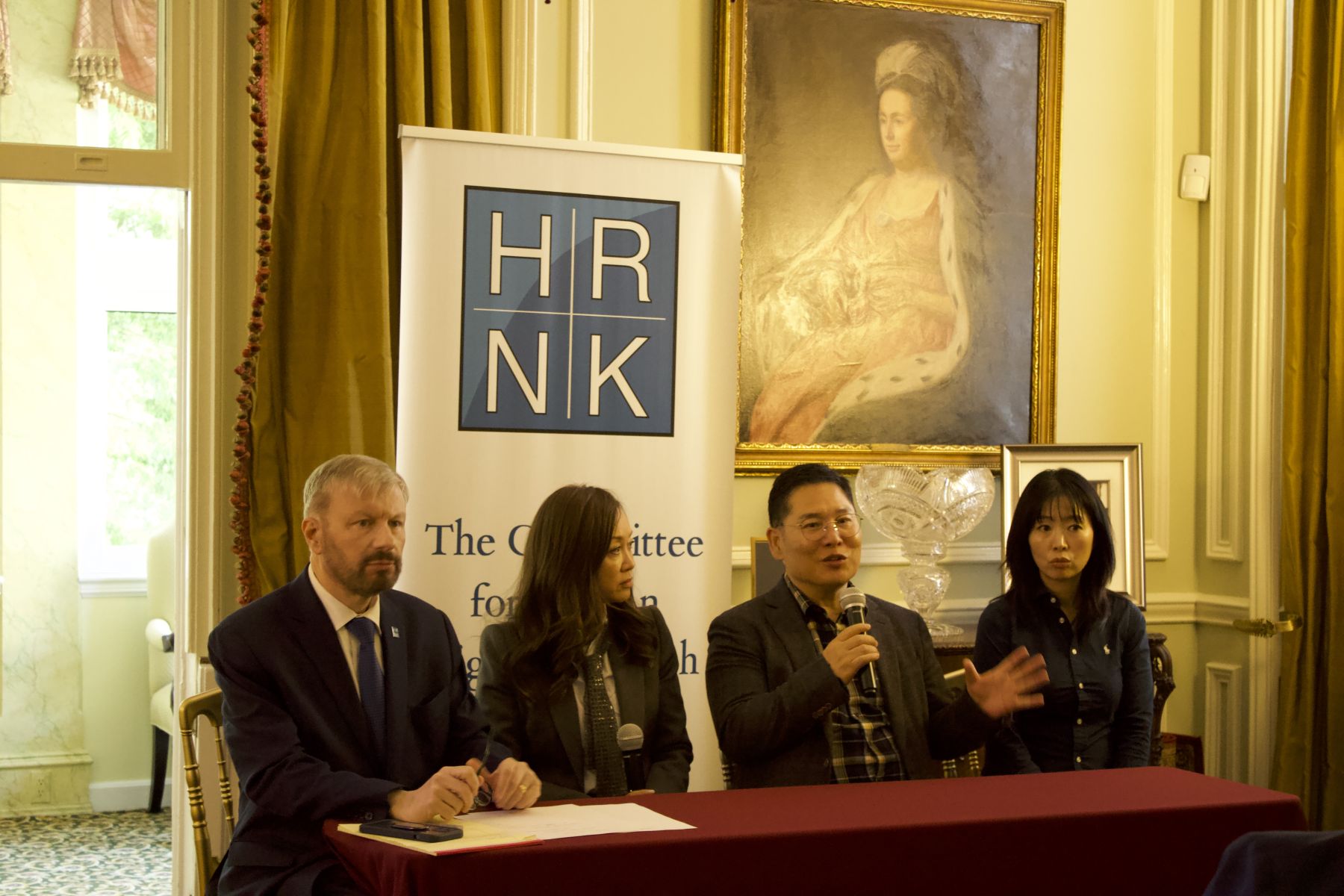
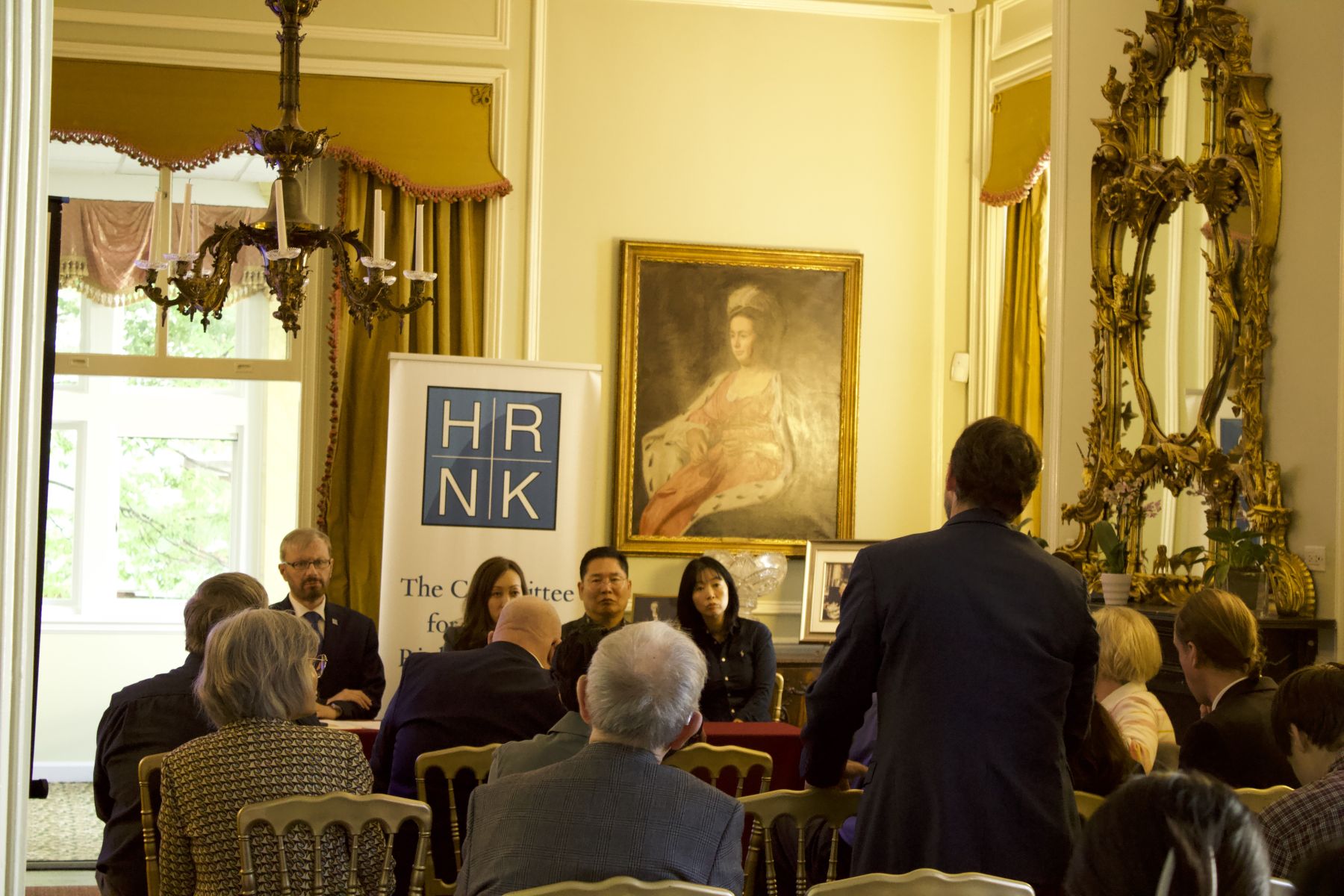
[04/22/2024] \"Beyond Utopia\" Screening & Discussion
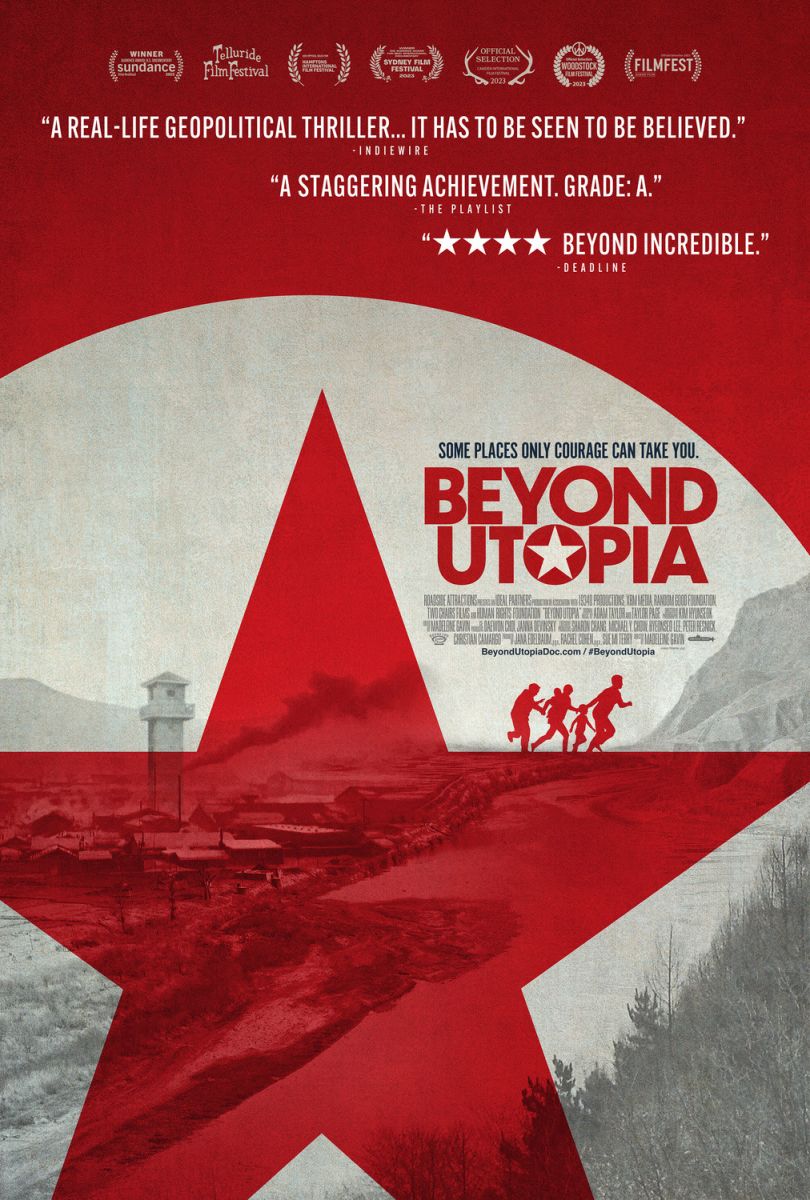
The Committee for Human Rights in North Korea (HRNK) is delighted to invite you to a screening of the award-winning documentary Beyond Utopia on Monday, April 22 from 3:00 to 6:00 p.m. at the DACOR Bacon House (1801 F Street NW, Washington, DC).
The screening will be followed by a discussion with co-producer Dr. Sue Mi Terry (Senior Fellow for Korea Studies, Council on Foreign Relations) and protagonist Pastor Kim Seung-Eun. HRNK Executive Director Greg Scarlatoiu will moderate.
Please click on this link to RSVP.
For media inquiries, please contact Greg Scarlatoiu at [email protected].
If you have any questions about this event, please contact Raymond Ha at [email protected].
[02/07/2024] The UN COI Report, A Decade Later: Problems, Prospects, Recommendations
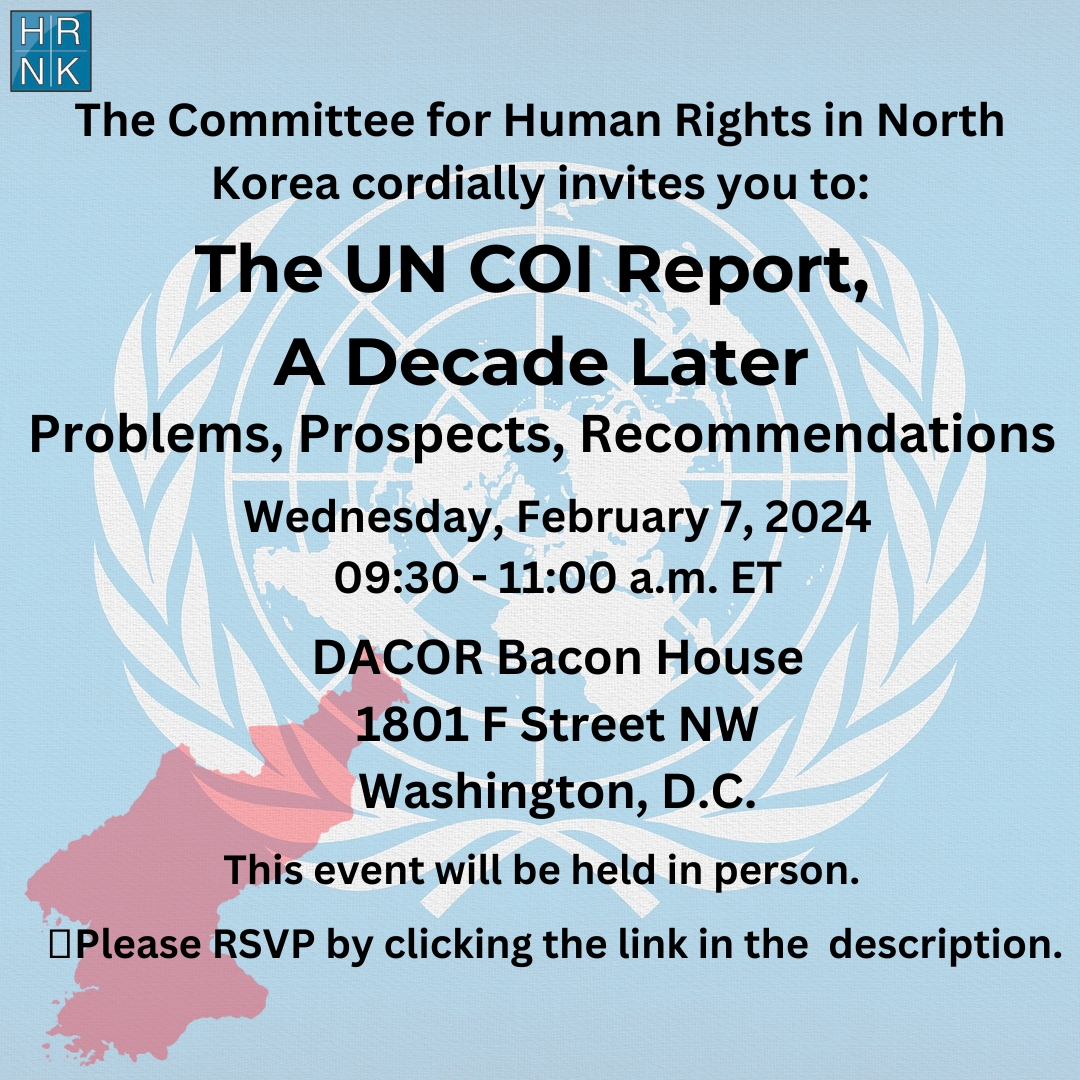
The Committee for Human Rights in North Korea (HRNK) is delighted to invite you to an event entitled The UN COI Report, A Decade Later: Problems, Prospects, Recommendations.
The event, which marks the 10th anniversary of the completion of the UN COI report on North Korean human rights, will be held in person on Wednesday, February 7 from 09:30 to 11:00 a.m. ET at the DACOR Bacon House (1801 F Street NW, Washington, DC).
This event will begin with a keynote address by Ambassador Julie Turner, the U.S. Special Envoy for N. Korean Human Rights Issues.
This will be followed by presentations from The Honorable Roberta Cohen (HRNK Co-Chair Emeritus) and Ambassador Robert King (former U.S. Special Envoy for N. Korean Human Rights Issues).
There will also be pre-recorded remarks by Ambassador Lee Shin-hwa (ROK Ambassador-at-Large for N. Korean Human Rights), The Honorable Michael Kirby (Chair, UN COI), and Sonja Biserko (Member, UN COI).
Greg Scarlatoiu, HRNK Executive Director, will moderate the discussion.
The event will be open to the press and on the record. Coffee, tea, and late-morning snacks will be served.
For media inquiries, please contact Greg Scarlatoiu at [email protected].
If you have any questions about this event, please contact Raymond Ha at [email protected].
[01/25/2024] The Sister: N. Korea's Kim Yo Jong, the Most Dangerous Woman in the World
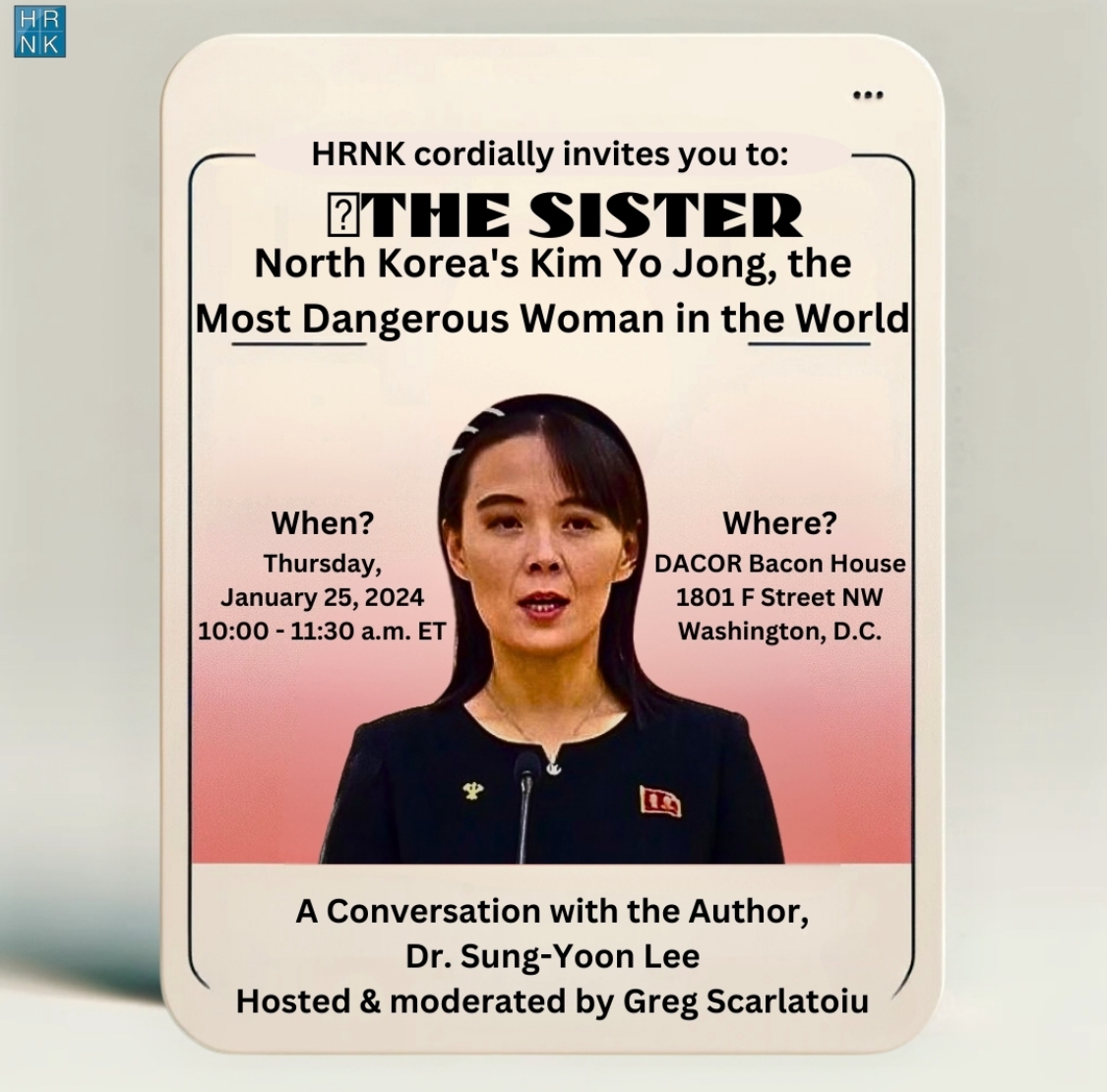
The Committee for Human Rights in North Korea (HRNK) is delighted to invite you to a conversation with Dr. Sung-Yoon Lee, author of The Sister: North Korea's Kim Yo Jong, the Most Dangerous Woman in the World.
The event will be held in person on Thursday, January 25 from 10:00 to 11:30 a.m. ET at the DACOR Bacon House (1801 F Street NW, Washington, DC).
The event will be open to the press and on the record. Coffee, tea, and late-morning snacks will be served.
The presentation and Q&A will be followed by a book signing. Copies of The Sister will be available for $20, in cash or checks made payable to the Committee for Human Rights in North Korea.
Per Dr. Lee's kind and generous offer, the proceeds from the book sales at the event will be donated to HRNK to support our mission of uncovering and telling the truth about the human rights situation in North Korea.
For media inquiries, please contact Greg Scarlatoiu at [email protected].
If you have any questions about this event, please contact Raymond Ha at [email protected].
[11/30/2023] Crafting Strategies for the Free & Peaceful Unification of the Korean Peninsula
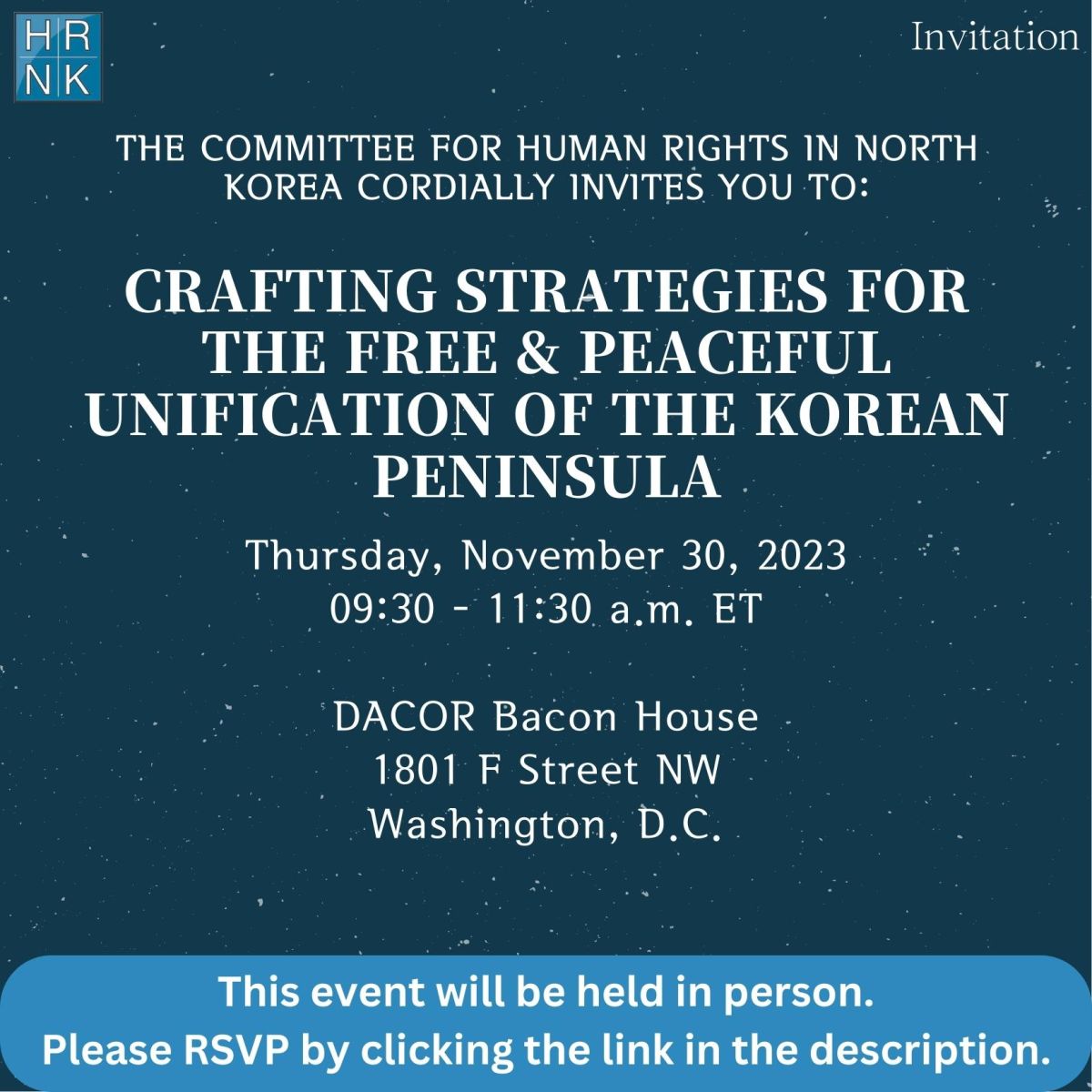
The Committee for Human Rights in North Korea (HRNK) cordially invites you to an event entitled "Crafting Strategies for the Free & Peaceful Unification of the Korean Peninsula."
It will be held on Thursday, November 30 from 09:30 to 11:30 a.m. ET at the DACOR Bacon House (1801 F Street NW, Washington, DC).
This event will address the current status of international efforts to improve North Korea's human rights situation, as well as the connection between human rights and the denuclearization of North Korea. The full schedule of events is enclosed below.
The event will be open to the press and on the record. Light refreshments will be served.
For media inquiries, please contact Greg Scarlatoiu at [email protected].
If you have any questions about this event, please contact Raymond Ha at [email protected].
(09:30 - 09:40) Introductory Remarks
Greg Scarlatoiu | HRNK Executive Director
Oh Dae-Seok | Director-General for Unification Planning, ROK Ministry of Unification
(09:40 - 10:30) Session 1: The UN COI, Ten Years Later
Roberta Cohen | HRNK Co-Chair Emeritus
Amb. Robert King | HRNK Board Member; former U.S. Special Envoy for North Korean Human Rights
Discussant: Olivia Enos | Senior Fellow, The Hudson
[11/29/2023] North Korea's Expanding Reach: Security, Human Rights, and Global Implications
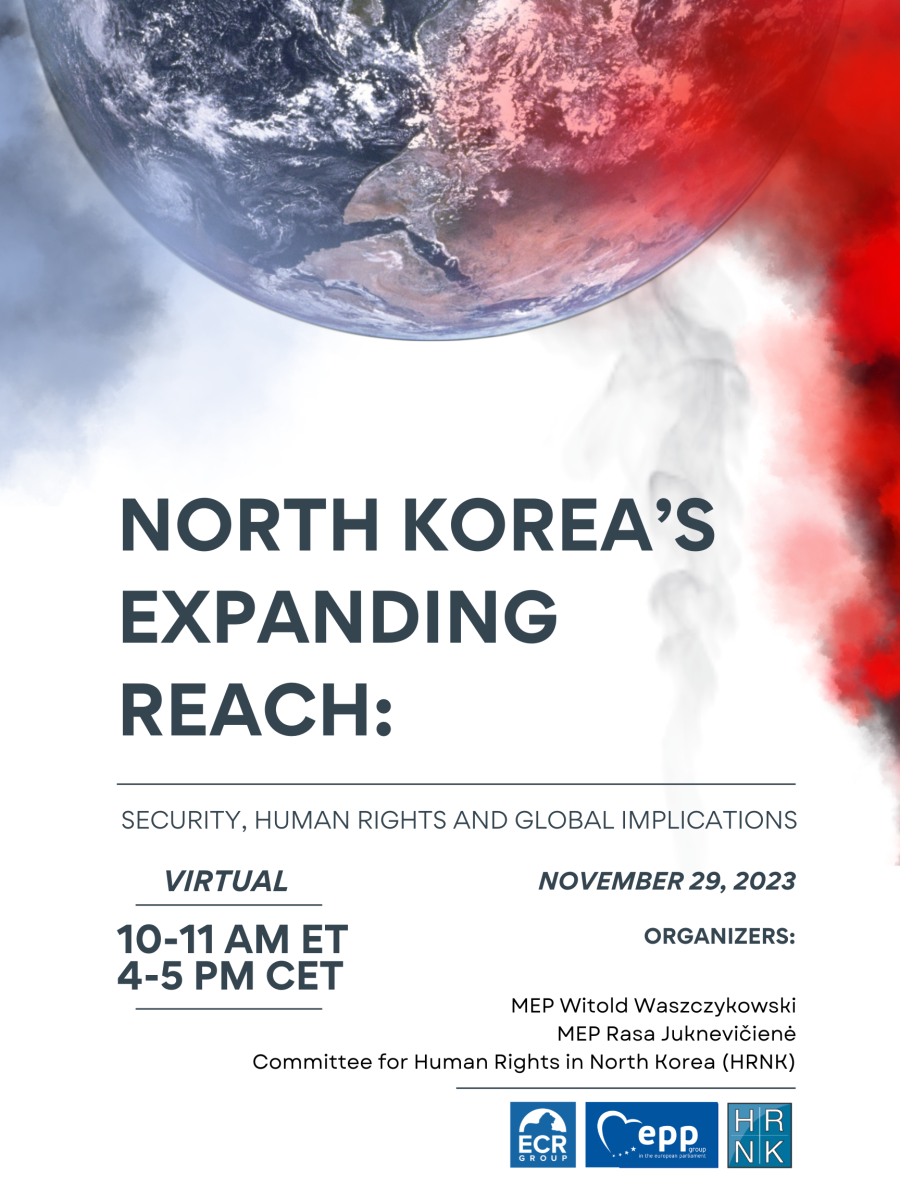
The Committee for Human Rights in North Korea (HRNK) cordially invites you to a virtual event on North Korea's Expanding Reach: Security, Human Rights, and Global Implications.
This webinar will be held on Wednesday, November 29 at 10 a.m. U.S. Eastern Time | 4 p.m. Central European Time.
It will bring together legislators from the European Union, as well as security and human rights experts, to explore the connections between human rights violations in North Korea, its nuclear and missile programs, and its arms exports to the Middle East, Africa, and Russia. The program agenda is enclosed below.
The RSVP form for the event is at https://forms.gle/R28ySABdPtW3CiC77.
All registered attendees will receive a Zoom access link prior to the event.
For media inquiries, please contact Greg Scarlatoiu at [email protected].
If you have any questions about this event, please contact Raymond Ha at [email protected].
Welcoming Remarks
Witold Waszczykowski | Member of the European Parliament
[Part 1] Exporting Violence & Instability: Exploring the DPRK's Role in the War in Ukraine
Dr. Bruce E. Bechtol Jr. | Professor, Angelo State University
Dr. Duyeon Kim | Adjunct Senior Fellow, Center for a New American Security
Moderator: Dr. Oskar Pietrewicz | Senior Analyst, Polish In
이미지 갤러리
In this submission, HRNK focuses its attention on the following issues in the DPRK: The status of the system of detention facilities, where a multitude of human rights violations are ongoing. The post-COVID human security and human rights status of North Korean women, with particular attention to sexual and gender-based violence (SGBV). The issue of Japanese abductees and South Korean prisoners of war (POWs), abductees, and unjust detainees.
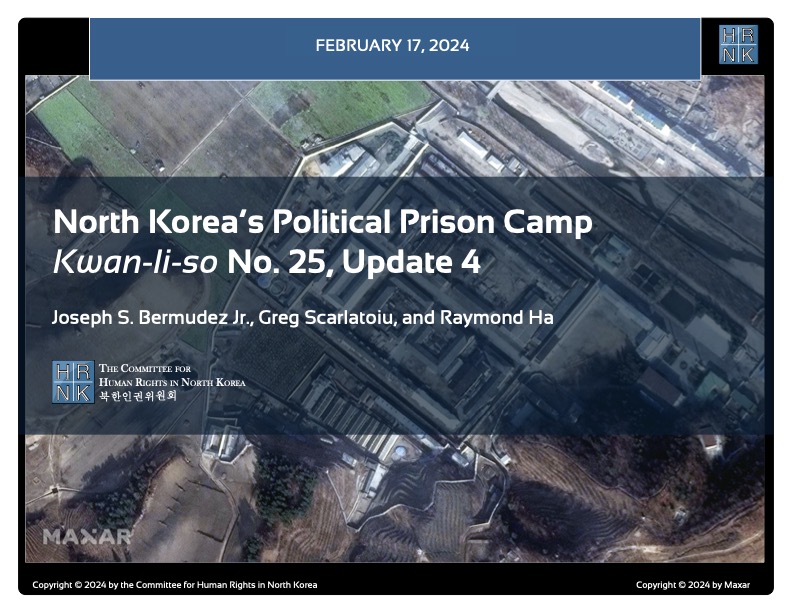
This report provides an abbreviated update to our previous reports on a long-term political prison commonly identified by former prisoners and researchers as Kwan-li-so No. 25 by providing details of activity observed during 2021–2023. This report was originally published on Tearline at https://www.tearline.mil/public_page/prison-camp-25.
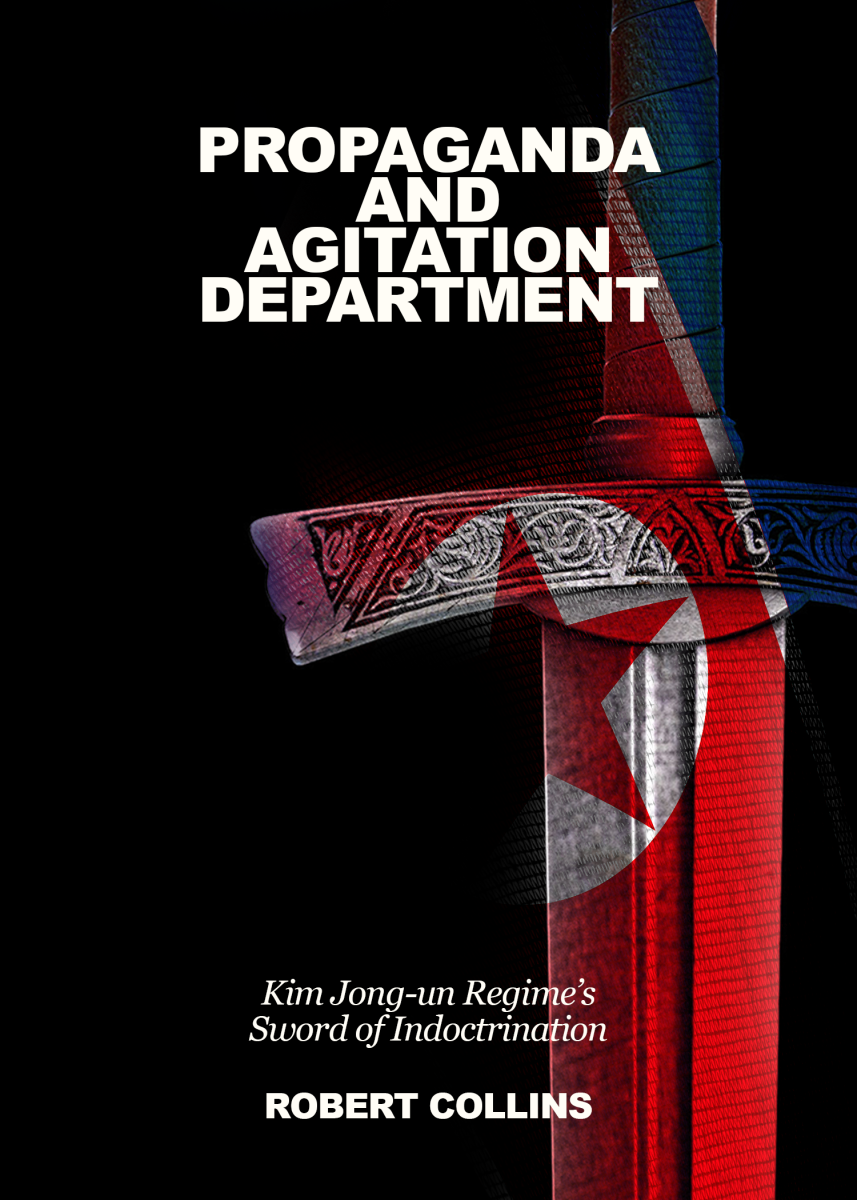
This report explains how the Kim regime organizes and implements its policy of human rights denial using the Propaganda and Agitation Department (PAD) to preserve and strengthen its monolithic system of control. The report also provides detailed background on the history of the PAD, as well as a human terrain map that details present and past PAD leadership.
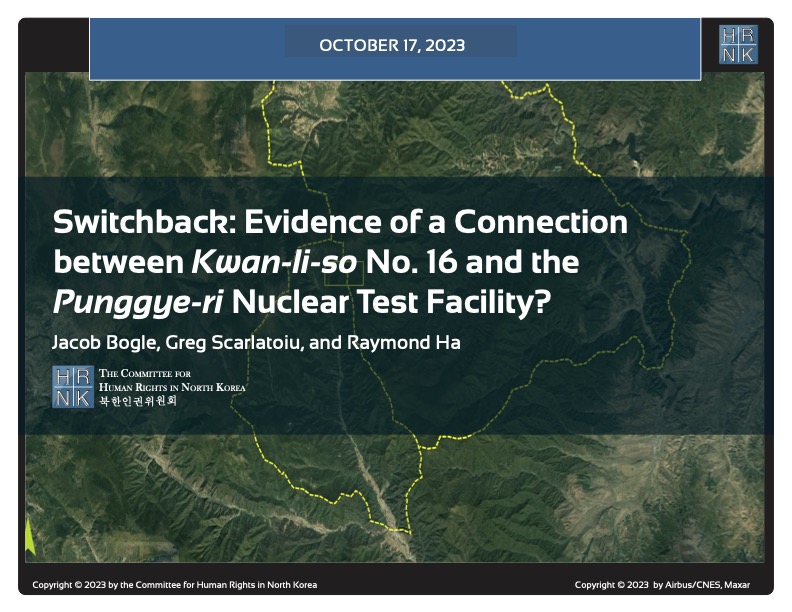
Oct 17, 2023
HRNK's latest satellite imagery report analyzes a 5.2 km-long switchback road, visible in commercial satellite imagery, that runs from Testing Tunnel No. 1 at North Korea's Punggye-ri nuclear test facility to the perimeter of Kwan-li-so (political prison camp) no. 16.
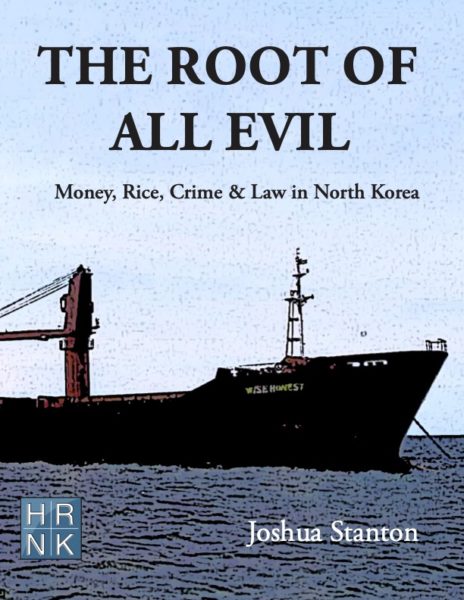
This report proposes a long-term, multilateral legal strategy, using existing United Nations resolutions and conventions, and U.S. statutes that are either codified or proposed in appended model legislation, to find, freeze, forfeit, and deposit the proceeds of the North Korean government's kleptocracy into international escrow. These funds would be available for limited, case-by-case disbursements to provide food and medical care for poor North Koreans, and--contingent upon Pyongyang's progress
For thirty years, U.S. North Korea policy have sacrificed human rights for the sake of addressing nuclear weapons. Both the North Korean nuclear and missile programs have thrived. Sidelining human rights to appease the North Korean regime is not the answer, but a fundamental flaw in U.S. policy. (Published by the National Institute for Public Policy)
Sep 26, 2022
North Korea’s forced labor enterprise and its state sponsorship of human trafficking certainly continued until the onset of the COVID pandemic. HRNK has endeavored to determine if North Korean entities responsible for exporting workers to China and Russia continued their activities under COVID as well.
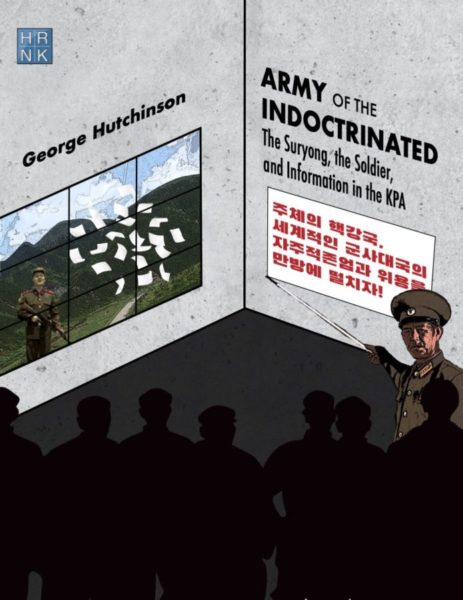
George Hutchinson's The Suryong, the Soldier, and Information in the KPA is the second of three building blocks of a multi-year HRNK project to examine North Korea's information environment. Hutchinson's thoroughly researched and sourced report addresses the circulation of information within the Korean People's Army (KPA). Understanding how KPA soldiers receive their information is needed to prepare information campaigns while taking into account all possible contingenc
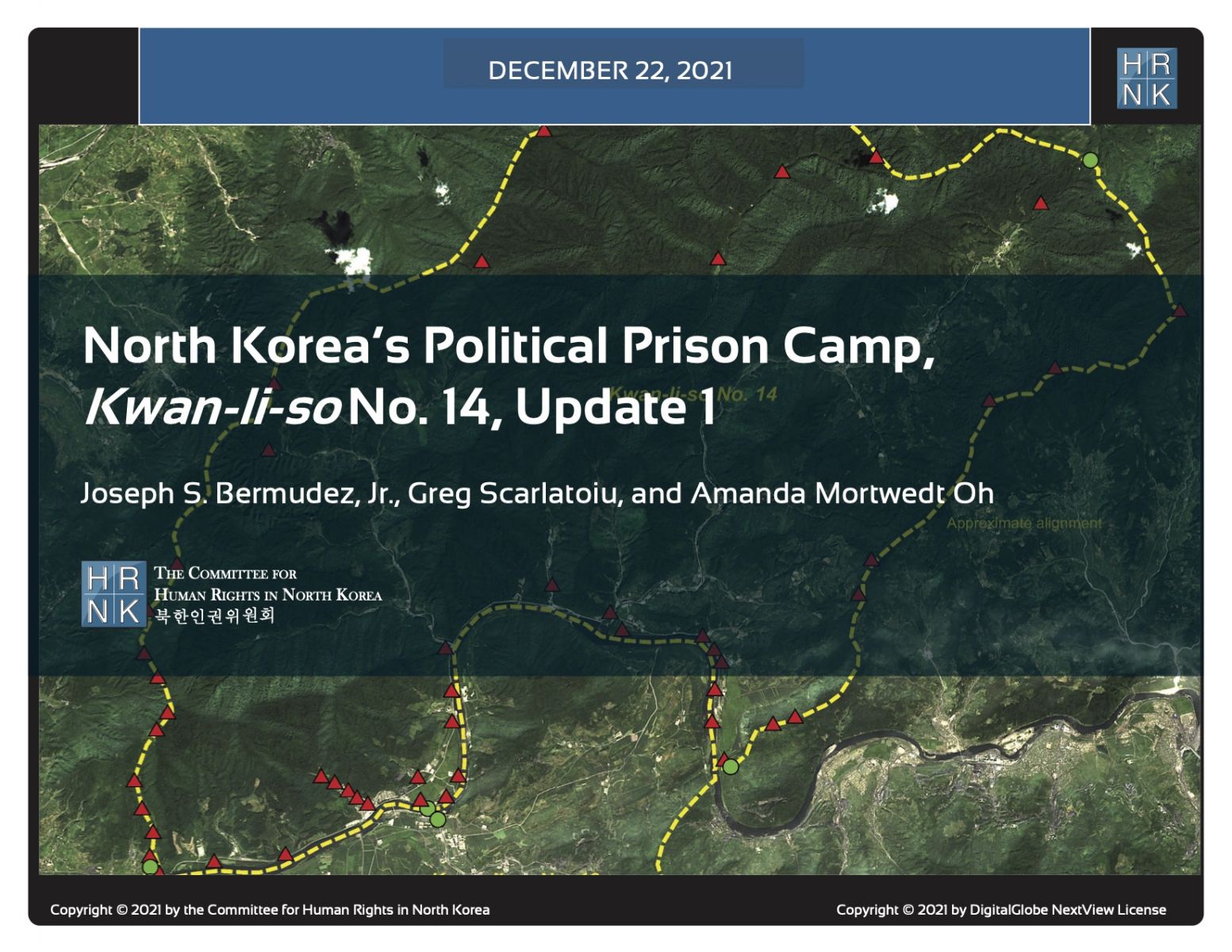
This report is part of a comprehensive long-term project undertaken by HRNK to use satellite imagery and former prisoner interviews to shed light on human suffering in North Korea by monitoring activity at political prison facilities throughout the nation. This is the second HRNK satellite imagery report detailing activity observed during 2015 to 2021 at a prison facility commonly identified by former prisoners and researchers as “Kwan-li-so No. 14 Kaech’ŏn” (39.646810, 126.117058) and
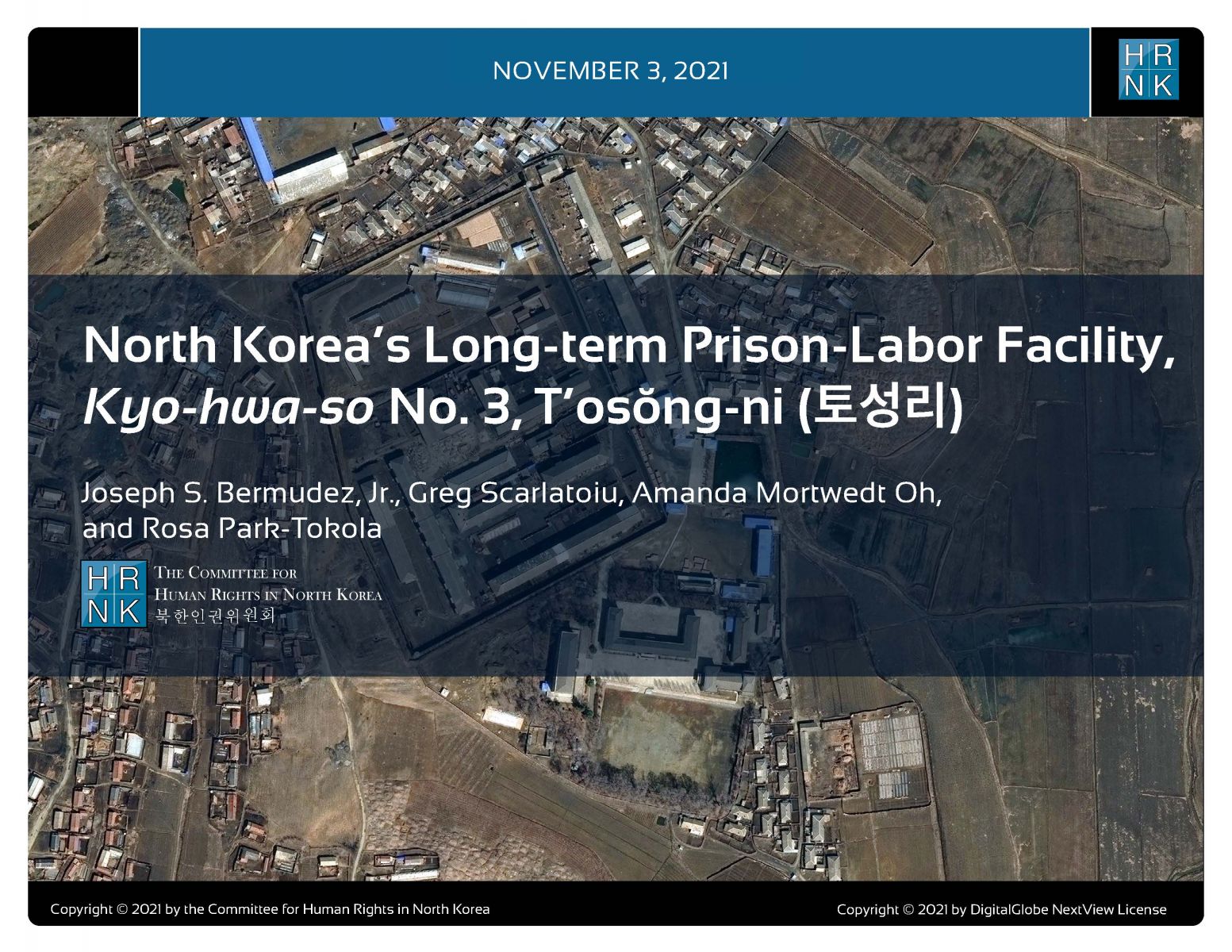
This report is part of a comprehensive long-term project undertaken by HRNK to use satellite imagery and former prisoner interviews to shed light on human suffering in North Korea by monitoring activity at civil and political prison facilities throughout the nation. This study details activity observed during 1968–1977 and 2002–2021 at a prison facility commonly identified by former prisoners and researchers as "Kyo-hwa-so No. 3, T'osŏng-ni" and endeavors to e
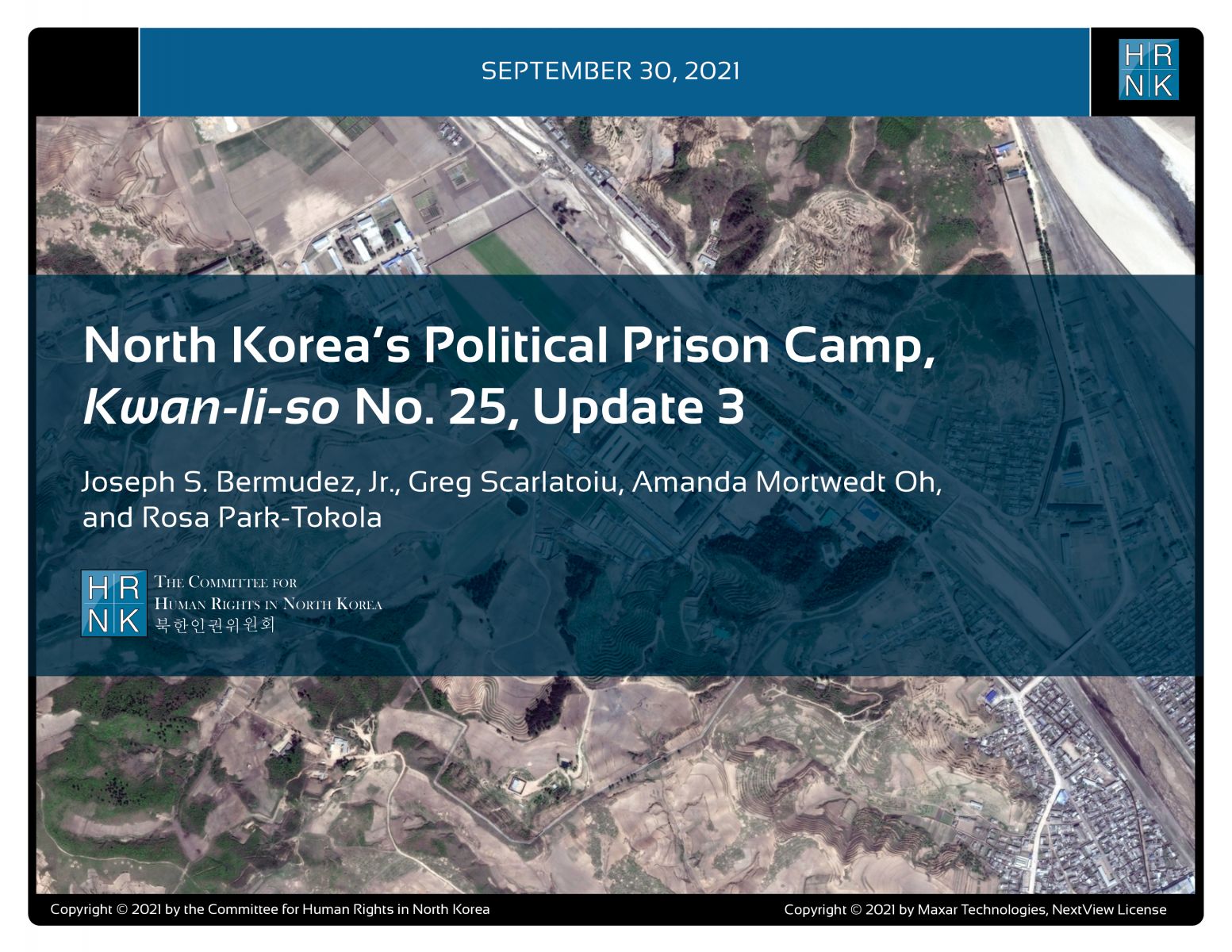
This report is part of a comprehensive long-term project undertaken by HRNK to use satellite imagery and former detainee interviews to shed light on human suffering in the Democratic People’s Republic of Korea (DPRK, more commonly known as North Korea) by monitoring activity at political prison facilities throughout the nation. This report provides an abbreviated update to our previous reports on a long-term political prison commonly identified by former prisoners and researchers as Kwan-li-so
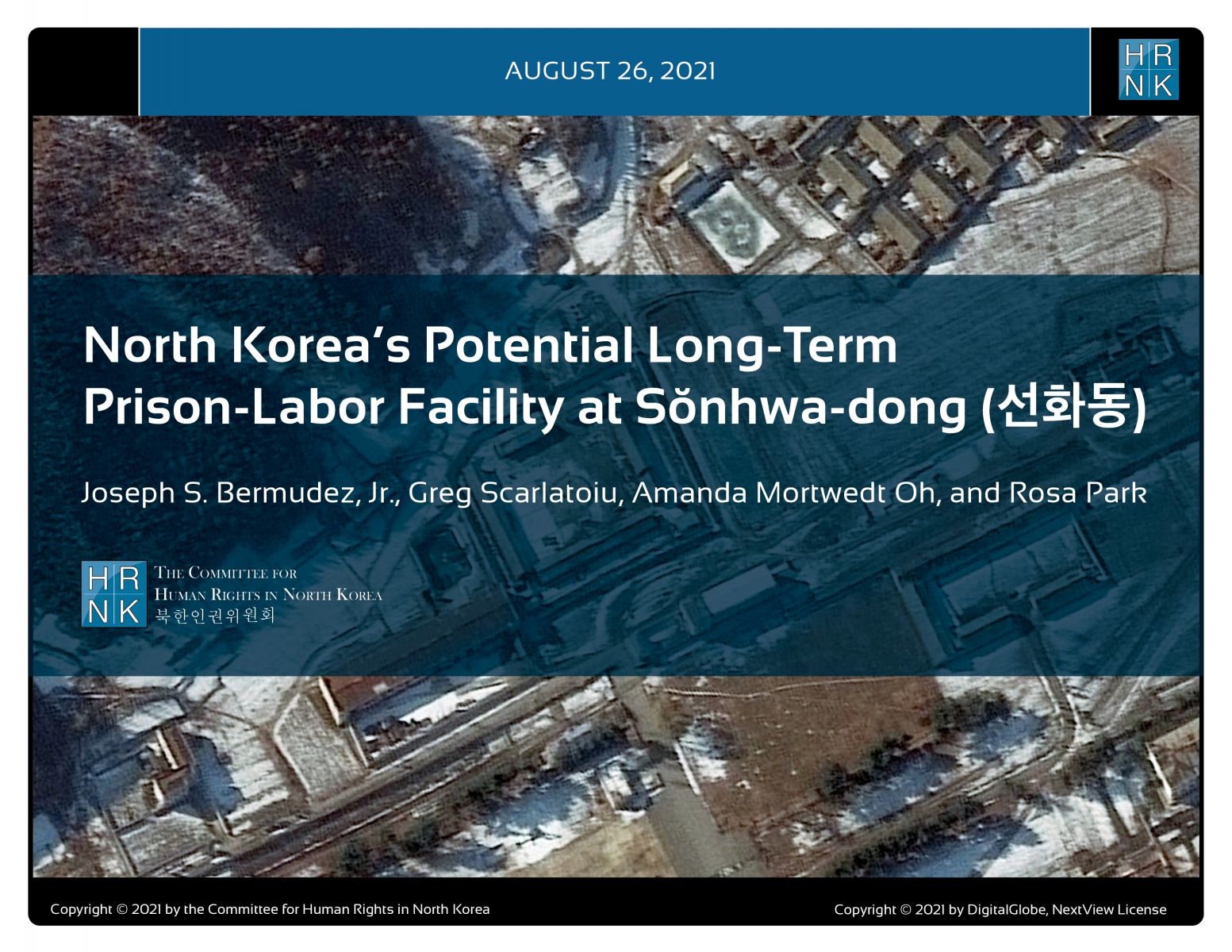
Through satellite imagery analysis and witness testimony, HRNK has identified a previously unknown potential kyo-hwa-so long-term prison-labor facility at Sŏnhwa-dong (선화동) P’ihyŏn-gun, P’yŏngan-bukto, North Korea. While this facility appears to be operational and well maintained, further imagery analysis and witness testimony collection will be necessary in order to irrefutably confirm that Sŏnhwa-dong is a kyo-hwa-so.
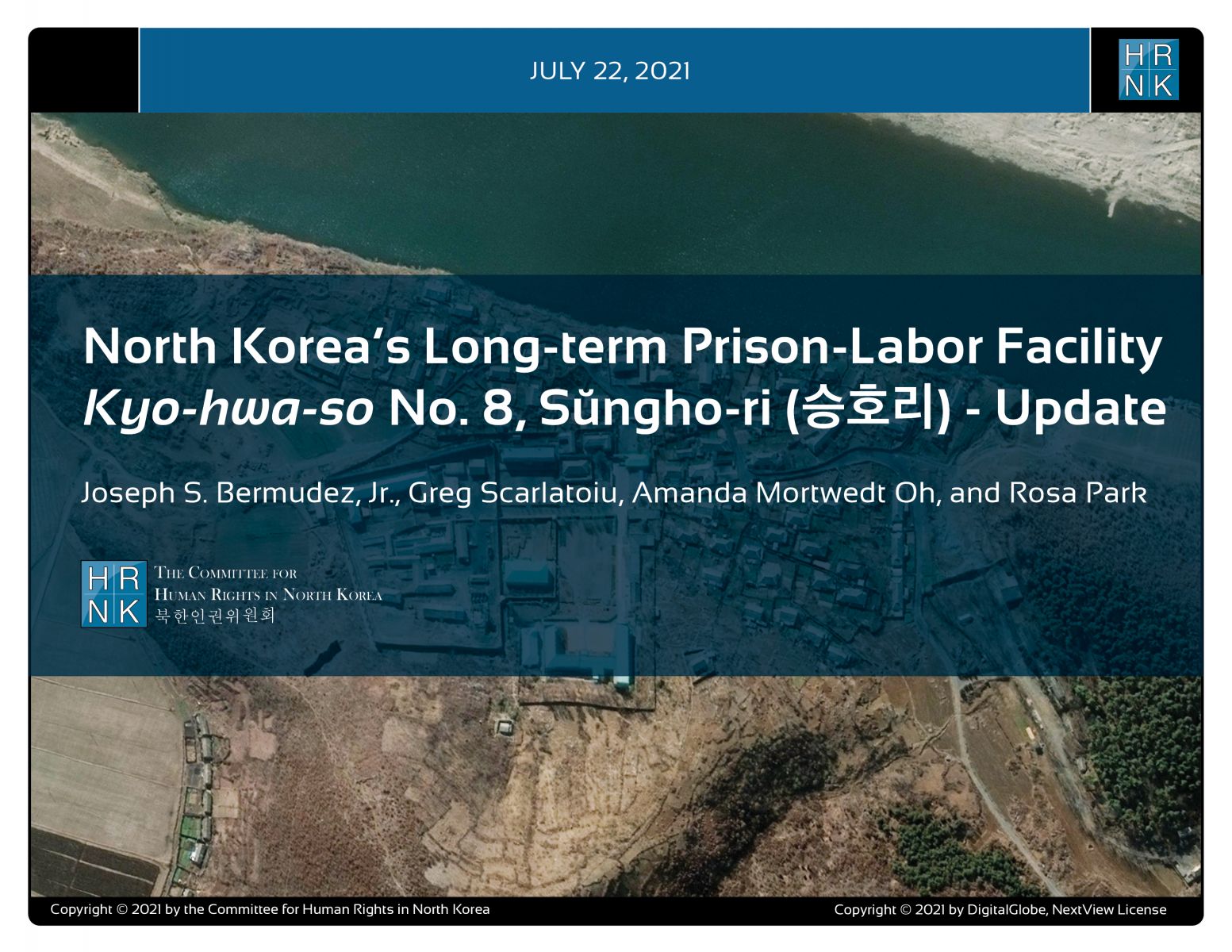
Jul 22, 2021
"North Korea’s Long-term Prison-Labor Facility Kyo-hwa-so No. 8, Sŭngho-ri (승호리) - Update" is the latest report under a long-term project employing satellite imagery analysis and former political prisoner testimony to shed light on human suffering in North Korea's prison camps.
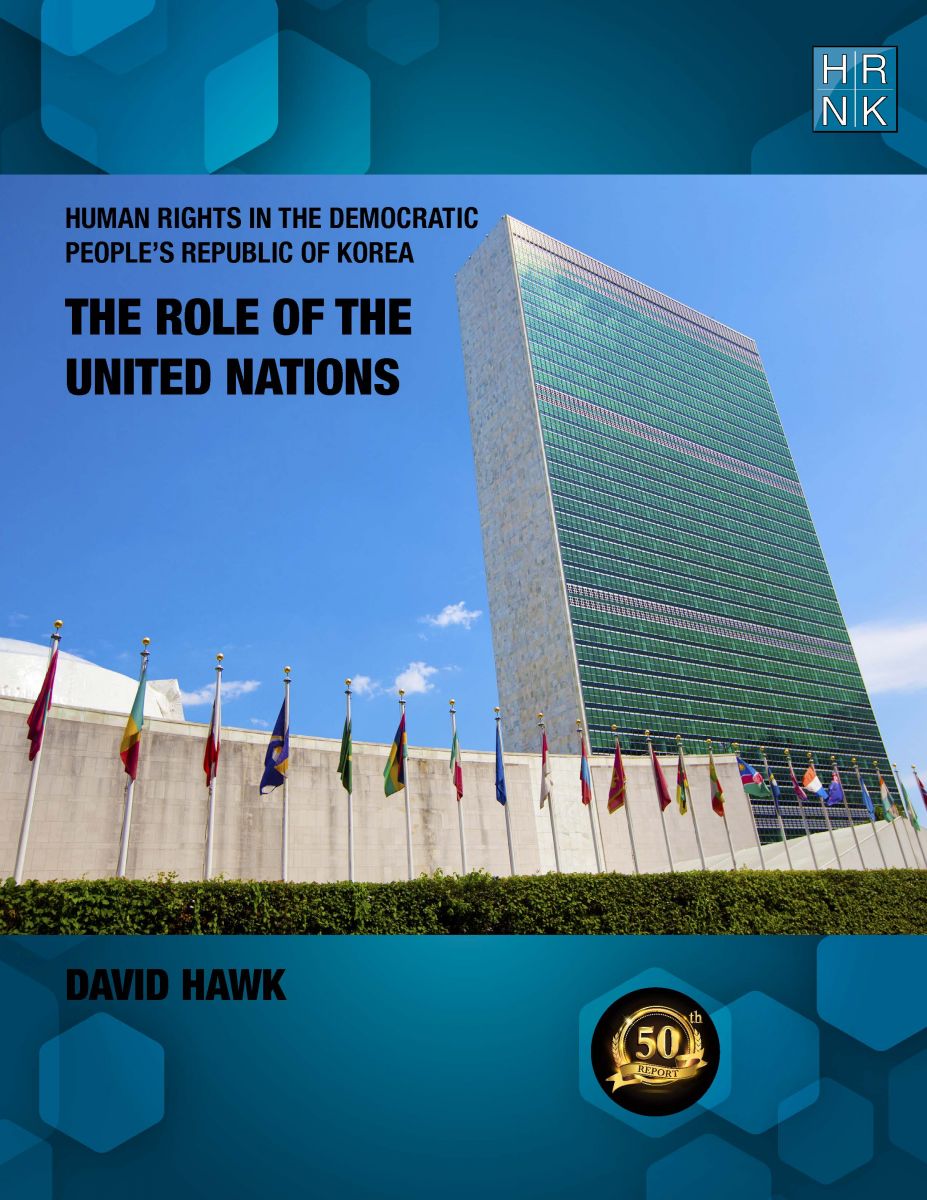
Jul 01, 2021
Human Rights in the Democratic Republic of Korea: The Role of the United Nations" is HRNK's 50th report in our 20-year history. This is even more meaningful as David Hawk's "Hidden Gulag" (2003) was the first report published by HRNK. In his latest report, Hawk details efforts by many UN member states and by the UN’s committees, projects and procedures to promote and protect human rights in the DPRK. The report highlights North Korea’s shifts in its approach
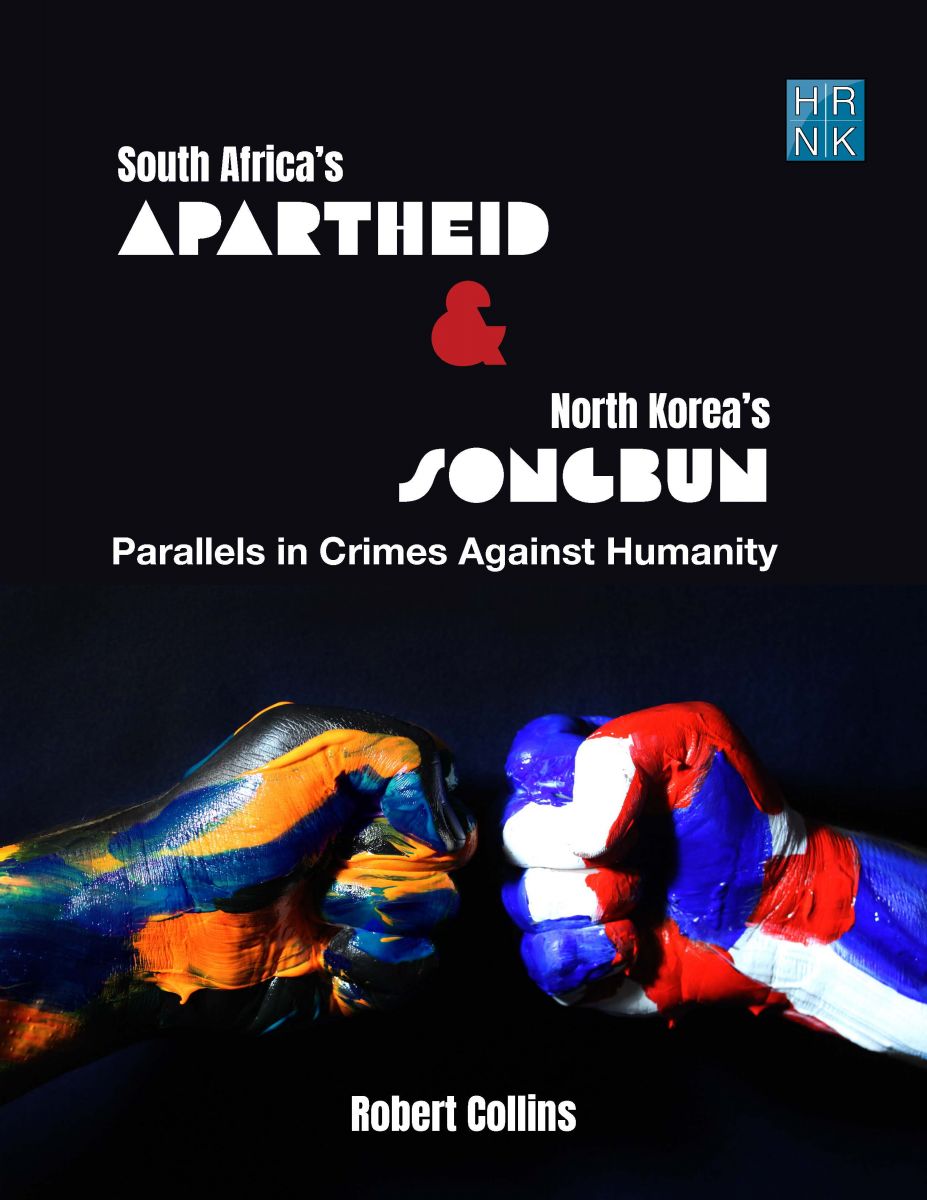

South Africa’s Apartheid and North Korea’s Songbun: Parallels in Crimes against Humanity by Robert Collins underlines similarities between two systematically, deliberately, and thoroughly discriminatory repressive systems. This project began with expert testimony Collins submitted as part of a joint investigation and documentation project scrutinizing human rights violations committed at North Korea’s short-term detention facilities, conducted by the Committee for Human Rights